

Megele, Buzzi and Longfield highlight the difference between the two terms. In their book ‘Safeguarding children and young people online’, they argue that although a term deeply connected to ideas of violence, radicalisation has been a tool of progress in history. They distinguish between the two concepts, stating that radicalisation is “open-minded” to new ideas (Megele, Buzzi and Longfield, 2018, p. 10). Extremism is defined as “closed-minded”, as it is the action of an ideological set group or individual (2018, p. 10). The key difference is the behaviour, as radicalisation simply takes place in discussing. Extremism is the possible execution of this outcome.

The UK’s strategy in dealing with counter-terrorism is present in their ‘Prevent’ scheme. This strategy, designed and published in 2011, aims to intervene early in cases of possible radicalisation. It has three main objectives –
- “To respond to the ideological challenge of terrorism and the threat we face from those who promote it.”
- “To prevent people from being drawn into terrorism and ensure that they are given appropriate advice and support.”
- “To work with sectors and institutions where there are risks of radicalisation that we need to address.” (Prevent in Megele and Buzzi, 2018, p. 214)
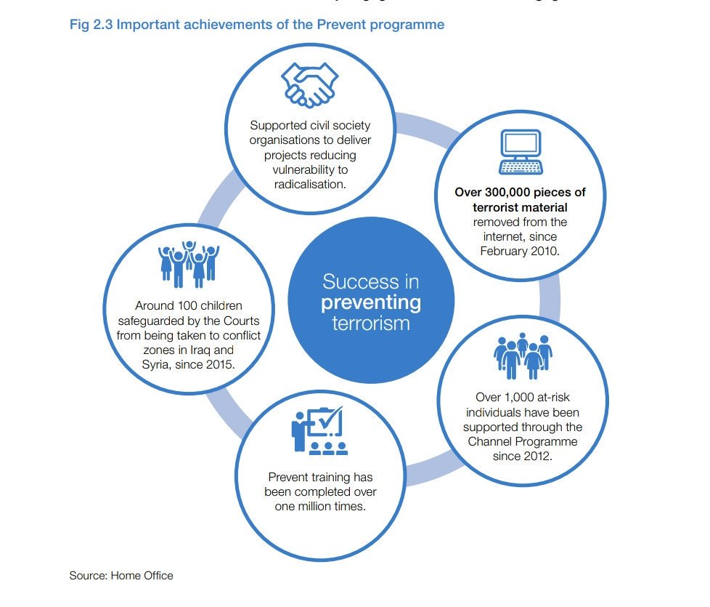
Clearly, for these objectives to be successful, operation must primarily focus on the internet. ISIS’ success in recruitment heavily relied upon its use of social media platforms (Golan, 2016, p. 4681). Liebelson notes that online companies such as Facebook, Google and Twitter actively sort to remove ISIS’ social media platforms (Liebelson in Golan, 2016, p. 4682). The Youth Justice Board indicates four attributes that are indicative of the completion of radicalisation –
- Having contact with people with similar challenges and experiences.
- Being involved in terrorism.
- Having contact or travelling to extremist networks overseas
- Having a serious criminal record.
References:
Golan, G. (2016) Third Person Effect of ISIS’s Recruitment Propaganda: Online Political Self-Efficacy and Social Media Activism. InInternational Journal of Communication 10(2016), 4681–4701 Los Angeles: Annenberg Press
Megele, C., Buzzi, P., & Longfield, A. (2018). Online radicalisation. In Safeguarding children and young people online: A guide for practitioners (pp. 213-234). Bristol, UK; Chicago, IL, USA: Bristol University Press.
 Cyberspace, Identity and Youth: A Portfolio