

This week’s lecture is focused on a classic topic of Sociological study, surveillance. One of the first examples given is that of the ‘panopticon’, Bentham’s concept of a continuously observed prison. I can clearly remember this as an example given in one of my first year, first semester university modules.

https://medium.com/@dylanskrah/the-data-panopticon-and-surveillance-capitalism-dee5cd1789d7
Foucault discusses this concept of prison surveillance in his work Discipline and Punish (1977). In this work Foucault explores the uses of punishment in the 18th century. Bentham was a Philosopher from this time period, and while the panopticon in in its exact form was never constructed, elements have been included in other prisons (Haralambos, 2014, p. 619). The central feature of the panopticon was a tower which would enable the prison official’s observation of all rooms in the prison, while obscuring the view of the prisoners. This had two effects, the inmates would not be able to see if they were being watched at any particular time and would not easily be able to view other inmate’s cells. Foucault identifies this system as an encouragement of ‘self-discipline’, teaching the inmates to regulate their own behaviours through the pressure of constant observation.
Recognising the significance of surveillance on our modern society, Giddens places it as one of the four key institutions of modernity.
- Capitalism. A clear feature present in society today, capitalism, Giddens argues, is intrinsically unstable and restless. This leaves the individual placed in society in a precarious position in modernity. 1990 (give book)
- Industrialism. This has increased the productivity of humans in this modern period. Although a closely linked concept to capitalism, it highlights the use of material goods, machinery and the production cycle at large.
- Surveillance. Drawing from the work of Foucault, Giddens here is referring to the observation of individuals within a ‘political sphere’ in order to monitor their behaviour. This political sphere can be extrapolated to all those who can engage in politics in one form or another. This therefore implicates any citizen of the nation, or those who may engage in protest. Essentially, this covers the entirety of society.
- The fourth and final key institution of modernity is military power. Giddens argues this relates to control over the means of violence.
(Giddens in Haralambos et al, 2013, p. 993)
Surveillance in cyberspace
A form of surveillance that is a common feature of modern society is that of employers researching potential employee’s social media accounts. In fact, the lecture this week began with a comic on this issue.
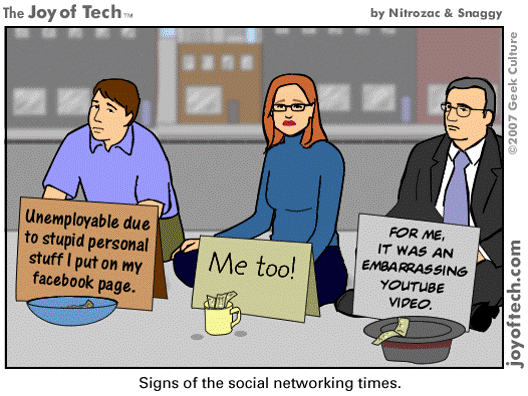
So prevalent is this action that law makers have begun to address this issue. Jolly notes that in German law it is now illegal for bosses to look up potential employees on Facebook (Jolly in Trottier and Lyon, year, p. 89). Due to the nature of social media, every action taken online creates more information about itself (known as metadata). This additional information allows detail to be extracted by any user with slight technical ability. An example of this is given by Lyon, who highlights the potential of data from geo-tagging in its surveillance capability (2007, p. 43).
References:
Foucault, M. (1977). Discipline and Punish: the Birth of the Prison. New York: Pantheon Books.
Haralambos, M., Holborn, M., Chapman, S., and Moore, S. (2013). Sociology Themes and Perspectives. London: Collins.
Lyon, D. (2001) Surveillance society: Monitoring everyday life. Buckingham: Open University Press.
Trottier, D. and Lyon, D. (2012) Key Features of Social Media Surveillance. In Fuchs, C. et al (Eds.) Internet and Surveillance. New York: Routledge. 89-105
 Cyberspace, Identity and Youth: A Portfolio