

Last week we briefly discussed gaming through the lens of ‘avatars’ – online representations of ourselves in a digital space. We explored Second Life in particular following the research of Ikegami. Now we will be exploring gaming in more depth, through ‘networked interactions’.
Gaming and gaming history.
Ahoy (2013). ‘A Brief History of Video Games’ [Video]
In this video from the Ahoy youtube channel, a demonstration is given of the development of video games.
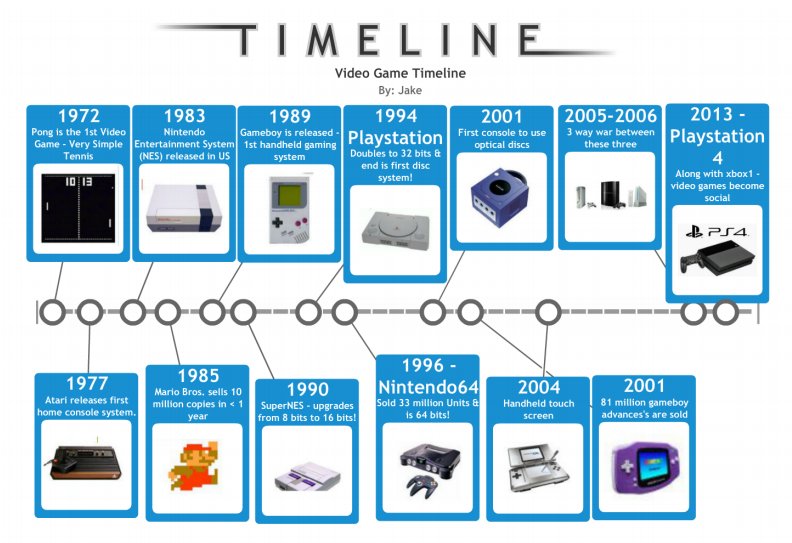
A timeline of key points in video games, with particular interest in the consoles that the games run on.
Simulation, Simulacra and Baudrillard.
In this video provided by Mitra and The University of Worcster, Dr. Alan How explains some of the key concepts as discussed by Baudrillard. How describes the key concept of Simulacrum/Simulacra as idiosyncratic used by Baudrillard, however it represents the way society simulates the real. There is an instability of meaning behind concepts, and the world is ‘hyper-real’.
“No more mirror of being and appearances, all of the real and its concept; no more imaginary coextensivity: rather, genetic miniaturization is the dimension of simulation. The real is produced from miniaturized units, from matrices, memory banks and command models-and with these it can be reproduced an infinite number of times. It no longer has to be rational since it is no longer measured against some ideal or negative instance. It is nothing more than operational.” (Baudrillard, p. 167).
References:
Ahoy (2013). A Brief History of Video Games [Video] Accessed online:
barbaramitra (2009) Baudrillard – ideas and concepts [Video] Accessed online: https://www.youtube.com/watch?v=80osUvkFIzI [date last accessed: ]
Baudrillard, J. (1988) “Simulacra and Simulacrum.” Selected Writings. Ed. Mark Poster. Stanford: Stanford UP.
 Cyberspace, Identity and Youth: A Portfolio