

This topic is the basis for understanding the rest of the module – youth are the ones who interact with cyberspace the most. They are the generation that grew up with these technological changes. To understand social media culture, we must first have an understanding of youth culture. In this blog post I will focus on discussing marginal and idle youth concepts. I will also discuss a journal article on the subject.

What is marginal youth?
As described in the lecture slides for this week, marginal youth is a period of adolescence that is seen as separate stage of life. It is the inbetween stage from childhood to adulthood, in which the skills required for adulthood are formed. Fulcher and Scott (2011, pp. 445) give account of the sociological theory on this topic. They describe this period as typically occurring in an individual’s’ twenties and even thirties, where they are independent from their families but do not hold all the responsibilities of adulthood – such as marriage.
What is idle youth?
“The idle youth are people who do not finish school as well as people who finish school but cannot attach to the labor force” – Montavlo, A. J. & O’Hara, A. (2008).
This is the quote that opened the slide ‘Idle Youth/Disconnected Youth’ in the lecture. It concisely categorises those who are not in training of the labour force as an ‘idle youth’. The term used by UK government for those who are not in school or the labour force is NEET (not in education employment or training).
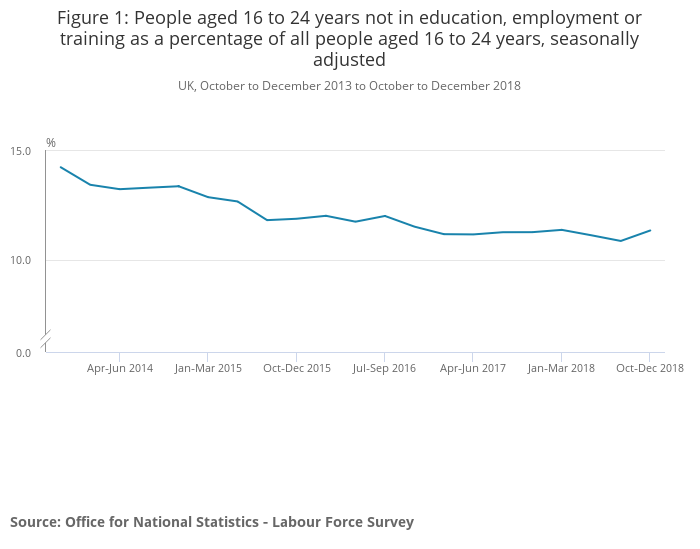
This graph from the UK Office for National Statistics shows that in October to December 2018 11.3% of 16-24 year olds were not in education, employment or training. This amounts to an estimate of 788,000 people.
Thompson, R. (2011). ‘Individualisation and social exclusion: the case of young people not in education,employment or training’.
This journal article examines the experiences of NEET, individualisation and social exclusion. In the opening Thompson gives account of the three discourses that attempt to explain this social exclusion (Thompson, p. 786). The first is focused on ‘relative material poverty’, based on ideas around income, benefits and taxation. The second is what he describes as ‘moral underclass discourse’ (p. 786). The third focuses on unemployment as the primary attribute in causing social exclusion.
Examples of marginal youth.
Video begins with Katt, an American youth who has struggled with homelessness. She is a client of Youth in Transition, an organisation set up to help those who are in this marginal phase of adolescence. The video briefly explores the stories of people like Katt, and the motivations of those who run the organisation. Interesting, the video also covers criminal charges filed against the founder Donna Rowe. Although, this is not directly related to youth identity it does make the video an interesting watch.
A return to the theory.
Is marginal youth always a negative experience? Heath and Cleaver (2003) make the case that this phase of post-adolescence should be seen in a more positive light, as this is when people work out how to ‘do’ adulthood.
Marginal vs idle youth?
What is the distinction between marginal and idle youth? From the theories discussed in the lecture, and in this wordpress portfolio post – marginal youth is the term used to represent the stage of all participants. Idle youth, or NEETs are those in this age group who are not typically participating in society to varying degrees. They are ‘idle’, and not working on any formal education or are in employment.
Conclusion.
As I discussed in my introduction to this post, this week serves as a foundation for future discussion of youth in cyberspace. It is an important place to start, as we will be discussing technologies that can dominate modern pre, during and post adolescent stages of life.
References:
Heath, S., & Cleaver, E. (2003) Young, Free and Single?: Twenty-Somethings and Household Change. Basingstoke: Palgrave Macmillan.
jamesrossmorrison (2013) Youth in Transition[Video]. Available online: https://www.youtube.com/watch?v=1YVD99vwa-s [Accessed 10/02/2019].
Montalvo, A. J., & O’Hara, A. (2008). A Profile of the Idle Youth in the US. In Annual Meeting of the Population Associaiton of America, New Orleans, LA on April (pp. 17-19).
Office for National Statistics (2019) Young people not in education, employment or training (NEET), Available at:
https://www.ons.gov.uk/employmentandlabourmarket/peoplenotinwork/unemployment/bulletins/youngpeoplenotineducationemploymentortrainingneet/february2019 [Accessed: February 2019]
 Cyberspace, Identity and Youth: A Portfolio